
Judge Pamela Pepper
Review evidentiary materials supporting an allegation that Judge Pamela Pepper was involved in behavior cognizable as misconduct, defined as “conduct prejudicial to the effective and expeditious administration of the business of the courts".
Review Evidentiary Materials Supporting Allegations That Chief Judge Pamela Pepper Is Engaged in Knowing, Intentional, and Ongoing Criminal and Constitutionally Offensive Conduct—Warranting Investigation, Removal from the Bench, and Criminal Prosecution.
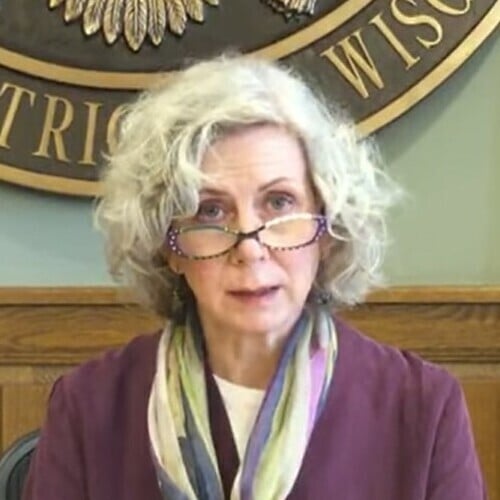
Alleged Judicial Misconduct: Assisting the Farmland Cover-Up
Dyer’s allegations against Judge Pepper begin with her role as the presiding judge in the 16-CR-100-PP criminal case, but expand to address her role as an alleged conspirator in the massive Farmland Partners, Inc. (NYSE: FPI) RICO scheme.
To begin with, Judge Pepper sentenced Dyer to 110 months of federal prison time without an attorney present at sentencing and without Dyer waiving his right to counsel. Additionally, the record reveals that at no time during the 16-CR-110-PP case proceedings was Dyer represented by any attorney, and he never waived his constitutional entitlement in a required Faretta colloquy.
In her orders relating to the 16-CR-100-PP and 19-CV-1319 Temporary Restraining Order (TRO) cases, Judge Pepper claimed Dyer appeared with standby counsel. Dyer never hired an attorney. Neither the magistrate handling pretrial proceedings nor Judge Pepper ever appointed Dyer counsel, standby or otherwise. No attorney ever filed an appearance or is listed in the docket as representing Dyer. No CJA 20 vouchers were filed by any attorney claiming time spent representing Dyer, and when Dyer filed motions to obtain copies of the CJA 20 vouchers proving no attorney represented him in the 16-CR-100-PP case, Judge Pepper dismissed his motions to conceal her own oversights and misconduct.
When these issues came to light following Dyer's March 8, 2017, incarceration, Dyer sent Judge Pepper a certified letter prior to filing a Complaint of Judicial Misconduct with the 7th Circuit Court of Appeals. In it, he asked her to identify who the attorney or attorneys she claims represented him were, when they were hired, and—if they were appointed—who appointed them: not unreasonable requests given Dyer's allegations. Judge Pepper refused to respond.
In the certified letter, Dyer informed Judge Pepper that attorneys Christopher Donovan (Donovan) and Martin Pruhs (Pruhs)—the attorneys appointed to represent Dyer as standby counsel in the 15-CR-115-JPS case, and the attorneys Judge Pepper likely alleges represented him in her case—have twice stated (once in a response to the Wisconsin Supreme Court's Office of Lawyer Regulation, and once in an email) that they were not appointed and did not represent Dyer in the 16-CR-100-PP case.
Based on Judge Pepper's refusal to respond, Dyer then filed a Complaint of Judicial Misconduct against Pepper. Chief Judge Diane Sykes and the Judicial Council dismissed Dyer's complaint, stating there was no evidence of bias. Dyer did not allege bias; he alleged Judge Pepper lied. However, any judge willing to claim in written court orders that a defendant had an attorney while knowing they did not is certainly biased against that defendant, guilty of misconduct, and not fit to be a federal judge.
Following that initial dismissal, Dyer refiled the Complaint of Judicial Misconduct with the new Chief Judge of the 7th Circuit, Michael B. Brennan, on November 20, 2026, giving him an opportunity to resolve the falsities in the prior filings and dismissal before Dyer discloses the obvious case of cronyism, protectionism, and violations of his rights under 18 U.S.C. §§ 241 and 243, which criminalize the behavior of a judge, prosecutor, and others who collude to intentionally deny a defendant's constitutional rights. If Judge Brennan refuses to correct the misconduct of his predecessor, Dyer will immediately refer the complete documentary record—including prior summary dismissals—to the United States Attorney General (Department of Justice Civil Rights Division) and the United States Senate Committee on the Judiciary regarding collusive, knowing, and intentional deprivations of constitutional rights under color of law.
As noted above, Dyer is seeking Judge Pepper's complete removal from the bench, asserting that this is no longer just about recusal from a single case under 28 U.S.C. §§ 144 and 455. While recusal merely removes a judge from a particular proceeding, Dyer is pursuing institutional accountability and disciplinary action that could cost Pepper her judgeship through the appropriate, legally authorized process.
Dyer alleges that Judge Pepper actively assisted in the misconduct of the 15-CR-115 Farmland case by weaponizing Case No. 19-CV-1319 to issue a Temporary Restraining Order. This order was specifically designed to prevent Dyer and his partner, Melvin E. Krumdick, from pursuing their partner and an alleged victim in the 15-CR-115-JPS case, Mark Borst, in state court—a legal action that would have forced Borst to admit he did not suffer financial losses as alleged on the record, and that there are direct structural connections between Midwest, American, and the publicly traded FPI which the government and others concealed.
JUDGE PAMELA PEPPER: DYER SEEKS HER REMOVAL FROM THE BENCH
As documented throughout this site and elsewhere, Dyer alleges that Midwest Farmland Partners and later, American Farmland Partners—businesses alleged to be part of a pre-planned scheme to defraud operated by Dyer and Dyer's co-defendant Nicholas C. Hindman, Sr. between March 2008 and September 2011, as documented in the federal government's 15-CR-115-JPS Farmland case—did not fail in September 2011 as alleged, but rather re-emerged as Farmland Partners, Inc. and its related entities, which went public in April 2014. [Fraud Alert 7]
The government's 15-CR-115 Farmland case also alleged that there is no connection between Midwest Farmland Partners, American Farmland Partners, and the publicly traded Farmland Partners, Inc. or any of its related entities. Finally, the government alleged that Midwest and American's securities were worthless, causing investors to lose a collective $1,800,000. [Fraud Alert 7]
Dyer has long alleged that Midwest and American did not fail in September 2011, but rather re-emerged through a number of concealed transactions as Farmland Partners, Inc. and its related entities, which went public in April 2014. Dyer has long alleged that there were no losses, and that Midwest and American's investors either had their shares repurchased by Hindman and others or received securities in FPI and/or a related entity in exchange for their Midwest and American securities prior to FPI's April 2014 IPO. [Fraud Alert 7]
In support of this claim, Dyer notes that in an FBI Form 302 Memorandum of Interview on November 25, 2014, alleged victim Mark Borst admitted his farmland securities were supposed to be valued at a minimum of $5.00 per share, but in the end were only worth $0.25. The 5,500,000 American Farmland Partners stock warrants in question were issued to Borst, Dyer, and partner Melvin E. Krumdick collectively through their designee, the Agri Business Investors Limited Partnership (ABILP), not to Borst individually. The stock warrants are or were binding to any successor to American, including, according to Dyer, the publicly traded Farmland Partners, Inc. (NYSE:FPI).
Dyer's claim, which he brought in state court, alleges Borst sold stock warrants for $0.25 that did not belong to him, but rather belonged to ABILP. Also relevant is the fact that when Dyer and Krumdick sued Borst for the unauthorized sale of ABILP's stock warrants, the government stepped in with its 19-CV-1319 Temporary Restraining Order prohibiting Dyer and Krumdick from suing Borst because he was a 15-CR-115-JPS case victim. Dyer pointed out that the 15-CR-115-JPS case covered only facts and occurrences between March 2008 and September 2011, whereas the state suit covered events that occurred later. Furthermore, Dyer wasn't bringing the suit against Borst individually, but rather ABILP was bringing the suit as the entity with standing regarding the stock warrants. Further, those warrants, when recognized and converted following FPI's April 2014 IPO, represent an undisclosed $70,000,000 liability on FPI's books and a loss of $70,000,000 to Krumdick and Dyer operating as ABILP. [Seventh Circuit order, Temporary restraining order]
The Investor Repayment Question
In an April 14, 2022 opinion, Judge Pepper admitted the possibility that one of the investors in American might have gotten some of their money back. Judge Pepper stated, in part:
“But if the victims did get some of their defrauded money back, the defendant—one of the people who defrauded them of that money—certainly would not be entitled to it.”
Dyer finds Judge Pepper's admission both incredible and unbelievable. Criminal cases and convictions are based on established facts, not presumptions. Judge Pepper's admission comes on April 14, 2022, more than 5 years into Dyer's 15-year federal prison sentence. If, in fact, some of the victims got some of their money back, that would be contrary to the factual basis of the 15-CR-115-JPS case, which alleges business failures, cessation of operations, and total loss. [Seventh Circuit order]
More importantly, Dyer inquires: Who paid Borst $0.25 for securities in a fraud scheme? How did Borst sell stock warrants belonging to ABILP without Dyer and Krumdick's authorization, consent, or knowledge? If someone associated with FPI or one of its affiliates bought the American stock warrants from Borst, and/or Borst exchanged stock warrants for FPI or affiliated entity securities, that invalidates the entire criminal case.
Dyer alleges Judge Pepper knows Midwest and American did not fail, that investors did not lose money, and that Borst sold and profited from stock warrants that did not belong to him, and is protecting Borst and others at Dyer's financial expense and in violation of Dyer's rights.
Alleged Judicial Misconduct: Assisting the Farmland Cover-Up
Dyer's allegations regarding Judge Pepper's role extend into a broader investigation of judicial misconduct, structural cover-ups, and the direct concealment of counsel's identity. Under the banner of the Zero Fear Whistleblower campaign, Dyer is seeking her complete removal from the bench, asserting that this is no longer just about recusal from a single case under 28 U.S.C. §§ 144 and 455. While recusal merely removes a judge from a particular proceeding, Dyer is pursuing institutional accountability and disciplinary action that could cost Pepper her judgeship through the appropriate legally authorized process. [Zero Fear Whistleblower]
Dyer alleges that Judge Pepper actively assisted in the misconduct of the 15-CR-115 Farmland case by weaponizing Case No. 19-CV-1319 to issue a Temporary Restraining Order. This order was specifically designed to prevent Dyer and Krumdick from pursuing Borst in state court—a legal action that would have forced Borst to admit on the record that there are direct structural connections between Midwest, American, and the publicly traded FPI. [Temporary restraining order, Fraud Alert 7]
Counsel, Records, and Judicial Accountability
This pattern of active concealment directly ties into severe procedural contradictions in her own case, United States v. Dyer, Case No. 16-CR-100-PP. The attorneys whom Judge Pepper's proceedings identified as representing or serving as standby counsel for Dyer have repeatedly stated on the record that they were never appointed to represent him in that prosecution. Their statements are documented, leaving a critical question completely unanswered: If these attorneys were never appointed, who was Dyer's lawyer? [March 17, 2020 order, Zero Fear Whistleblower]
Dyer was sentenced on March 23, 2017, and contends that Judge Pepper sentenced him to 110 months while standing before the court completely stripped of his constitutional right to legal counsel. Dyer alleges that Judge Pepper knowingly lied in her official orders by claiming he had an attorney when she knew he did not. Despite this, Pepper has refused to identify the attorney she claimed represented Dyer, and she further denied Dyer's requests for CJA-20 voucher records—the exact financial logs that would establish whether counsel was ever officially appointed and compensated by the court. Who authorized these attorneys to act as his counsel? Where is the appointment order? Where are the records? Why has the court provided evasions instead of straight answers? [CJA-20 records order, Zero Fear Whistleblower]
This pattern of alleged misconduct is further supported by several other documented actions within her court, including:
- The denial of access to CJA-20 records.
- The withholding of the Revised Presentence Investigation Report (PSR), which Dyer asserts he never received prior to sentencing.
- The failure of the court to address his formally filed objections to the presentence report.
- Unresolved questions regarding grand jury records.
- The failure to properly address his documented bipolar disorder. [Zero Fear Whistleblower]
When Dyer challenged these violations through a formal judicial-misconduct complaint, the complaint was denied by the Judicial Council. Dyer alleges that this process was also compromised, asserting that former Seventh Circuit Chief Judge Diane Sykes—a close personal associate of Pepper—was intentionally asked to handle the complaint in a manner that protected Pepper from accountability. This allegation demands severe independent scrutiny of the documented complaint, the decision-makers, the procedures followed, and the structural reasons behind the disposition. The public deserves complete transparency regarding how complaints involving federal judges are handled, and complaints must be evaluated strictly on their merits. [Zero Fear Whistleblower]
RICO Conspiracy Allegations
Dyer alleges that, according to this cumulative behavior—from leveraging 19-CV-1319 to shield asset conversion in the Farmland matter to the structural concealment of constitutional defects regarding lack of counsel in 16-CR-100-PP—Judge Pepper is a potential conspirator in a massive, ongoing RICO scheme.
To bring someone into a RICO (Racketeer Influenced and Corrupt Organizations Act) scheme as a conspirator under 18 U.S.C. § 1962(d), the government does not need to prove that the individual personally committed any crimes. Instead, the legal requirement centers entirely on an agreement. As established by the U.S. Supreme Court in Salinas v. United States, a person can be swept into a RICO conspiracy if they:
- Intended to further an endeavor that, if completed, would satisfy all elements of a substantive RICO offense.
- Knowingly agreed to facilitate the scheme, with general knowledge of the conspiracy's overall objective and scope.
Unlike the general federal conspiracy statute, a RICO conspiracy requires no overt act. A defendant does not need to be an operator or manager of the enterprise, nor do they have to personally commit or agree to commit the two “predicate acts” required to establish a pattern of racketeering. If they knowingly agree to help the broader criminal partnership succeed, they are liable for the conspiracy. Actively hiding evidence, concealing documents, or destroying files to impede a federal investigation satisfies 18 U.S.C. § 1503 or § 1512, which are valid RICO predicate acts.
Articles & Documents
Article 1: Pepper's Order and Report and Recommendation
Judge Pepper's order adopting the magistrate judge's report and recommendation states that Dyer appeared with standby counsel. The highlighted exhibit identifies the order's “and stand-by counsel” wording.
Read the CaseMine copy of the order (PDF)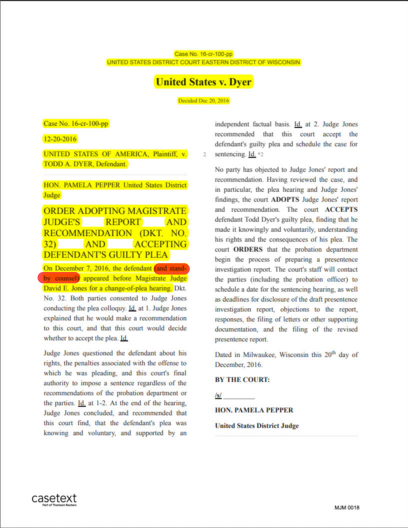 View Evidence in Support
PDF
Article 2: Donovan and Pruhs's Email on Representation
The January 9, 2019 email exchange concerning Donovan and Pruhs's representation of Dyer, in which Donovan states that they were only standby counsel for the trial before Judge Stadtmueller. Exhibit 9 in the memorandum on this site includes the exchange and Dyer's January 10 follow-up.
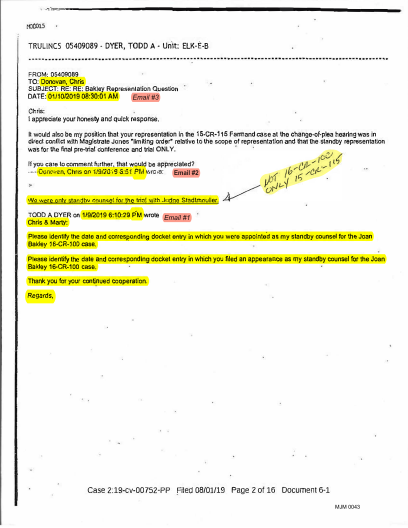 View Evidence in Support
PDF
Article 3: Letter to Judge Stadtmueller
Donovan and Pruhs's January 19, 2017 letter to Judge Stadtmueller states that they were not appointed as standby counsel in the 16-CR-100 Bakley case. Exhibit 3 in the memorandum documenting misconduct on this site.
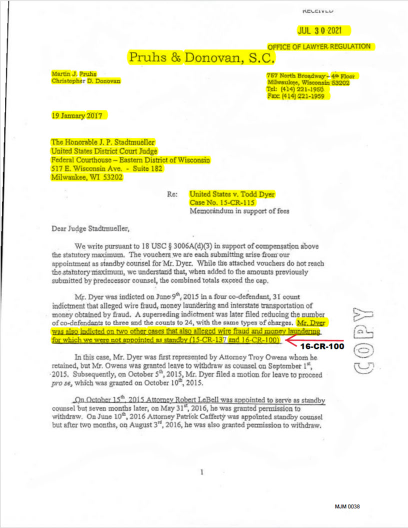 View Evidence in Support
PDF
Article 4: Dyer's Letter Asking Pepper to Identify Counsel
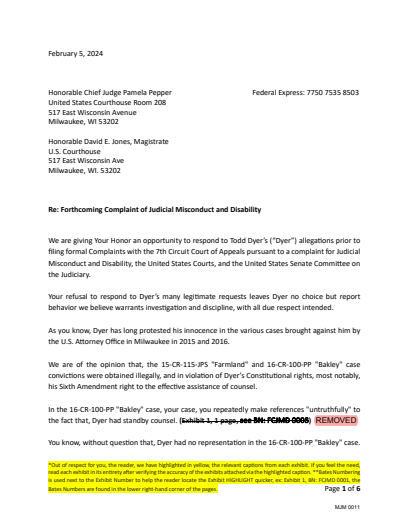
Dyer's letter asks Judge Pepper to identify who represented him in Case No. 16-CR-100. Exhibit 11 in the memorandum includes the letter and FedEx proof of delivery showing receipt on February 7, 2024.
 View Evidence in Support
PDF
Article 5: Judge Pepper's Order on Investor Repayments
Judge Pepper's 2022 order addressing the possibility that investors may have gotten some of their money back.
 View Evidence in Support
Pending PDF